


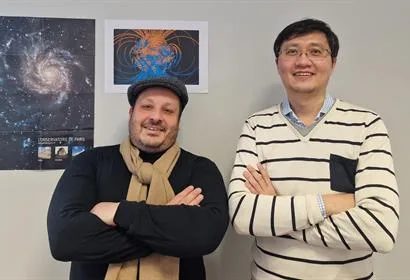
When Machine Learning is integrated into the world of fundamental physics, the result is an outstanding paper presented at the European Geosciences Union General Assembly held in Vienna last May. The authors? Two research professors in applied mathematics at ECE… Meet Waleed Mouhali and Jae Yun Jun Kim .

What research is behind the title of your paper: “Velocity field reconstruction by Machine Learning during kinematic dynamo process” ?
Waleed Mouhali: the Earth is surrounded by a magnetic field that protects us from cosmic rays and solar winds. It forms a “shield” whose study enables us to understand the structure and internal dynamics of the Earth, as well as phenomena occurring in the upper atmosphere and in space. This magnetic field is generated by the “dynamo effect” via movements called “convection” of liquid iron in our planet’s core. It can be identified by magnetic field lines. Far from being immutable, it evolves in time and space. Around its north and south poles, pole reversals occur at random, cancelling out the magnetic field and depriving certain areas of the Earth of protection.
Understanding geomagnetism opens up a wide range of applications. In 2019, with M2 students, we developed a magnetic field mapping methodology inspired by biomimicry (1).
Jae Yun Jun Kim: Our research project is similar in philosophy, but its originality lies in the choice of using Machine Learning to model a kind of magnetic GPS capable of tracking variations in magnetic field lines. Understanding the data processing algorithms associated with Machine Learning is central.
What does Machine Learning have to offer?
Waleed Mouhali: First of all, you need to know that the convection movements of liquid iron in the Earth’s core are physically represented by velocity fields. To understand the spatial organization and evolutionary dynamics of magnetic field lines, we need to solve complex equations modeling the dynamo effect, based on velocity fields linked to flows. This requires resource-intensive and time-consuming calculations.
Jae Yun Jun Kim: Conversely, generating velocity fields from known magnetic fields has always been very difficult to solve. This is precisely where Machine Learning shows great promise. Machine Learning is a discipline of study that uses mathematical and statistical approaches to give machines the ability to learn, i.e. to improve their performance in solving tasks without being explicitly programmed for each one.
Two steps are fundamental. In a first coding phase, we’ll “feed” the machine with velocity field data inherited from direct simulations to learn how to generate the magnetic field. In a decoding phase, we learn to reconstruct the velocity field from the magnetic field “learned” during the coding phase. The aim is to minimize the error between the reconstructed velocity field and the initial velocity field. Each step involves a Deep Neural Network , in practice layers of interconnected neurons inspired by the organization of the nervous system (2). To find our velocity field from a magnetic field, we simply use the second decoding step. At this conference, we proposed a new methodology capable of reconstructing the velocity field associated with real magnetic field data. Our velocity field data will be able to feed direct simulations of the dynamo effect and, by hypothesis, enable better prediction of magnetic field lines.
What’s next?
Waleed Mouhali and Jae Yun Jun Kim: our paper at the EGU attracted real interest, as we received a collaboration proposal from a joint team at the University of Heidelberg and the Helmholtz-Centre Potsdam*. It could provide us with random magnetic field data to refine our methods. We are also collaborating with Thierry Lehner, astrophysicist at Paris Observatory, to obtain data from numerical simulations of the dynamo effect. But Machine Learning, and AI in general, remains a tool. The intuition, creativity, analysis and scientific rigor of researchers remain paramount at a time when a new digital era is opening up with AI and quantum computing!
*GFZ: German Research Centre for Geosciences