



For a greener planet
What is the Engineer Cycle – Major in Energy Transition ?
The Energy Transition Engineer Program at ECE is taught in French and English on the Paris campus. It trains engineers who can understand the complex dynamics of the energy sector and design innovative solutions to the economic, social, and technological challenges related to energy production and consumption.
Climate change is one of humanity’s greatest challenges: decarbonization is urgent and the energy transition is one of the most effective levers for action. Over 2 years (2nd and 3rd year of the Engineer Cycle), you will develop strong analytical and decision-making skills, utilizing digital tools and artificial intelligence to optimize energy systems.

The targeted professional certification
The Energy Transition Engineer Program leads to the ECE engineer title, a level 7 diploma accredited by the Commission des Titres d’Ingénieur (CTI), registered in the RNCP. This diploma certifies a rare mastery: that of the technical, economic, and financial aspects of the energy sector, combined with expertise in industrial transformation and artificial intelligence. ECE is a member of the Conférence des Grandes Écoles (CGE).
From energy production to industrial decarbonization
Objectives and skills acquired
This major trains engineers capable of acting across the entire energy chain.
-

Gain a thorough understanding of all technical, economic, and financial aspects of the energy sector: production, transmission, storage, distribution, end-use, and energy in housing, cities, and ICT.
-
Identify the key challenges, drivers, and constraints of energy transition policies.
-
Anticipate changes and innovations in the energy sector.
-
Harnessing artificial intelligence to optimize energy systems.
-
Developing innovative solutions for the decarbonization of industry and regions.
-
Assess the energy performance of buildings, smart cities, and infrastructure.
At the crossroads of engineering, economics, and AI
The content
The program is based on courses from the official reference framework of the major. Their content is updated annually to align with the realities and advancements of the energy sector.
Evaluation Methods
Progress is measured throughout the two years through modalities that reflect the real challenges of the energy sector:
- Modeling and optimization projects of energy systems based on real data.
- Case studies on issues of industrial decarbonization or smart city.
- The Multidisciplinary Group Project (PPE) and the Final Study Project (PFE).
- A report and a presentation before a committee at the end of each internship
- An international academic stay is mandatory in the 1st or 3rd year of the Engineering cycle, validated with a partner university of ECE.
A diploma recognized by the State and valued internationally
Yes. This training delivers a professional certification registered with RNCP by France Compétences (Ministry of Labor), attesting to the recognition of the diploma and the alignment of job skills with business needs.
Certified by the State
Validated Skills
Prepares for employment
Professional immersion
Experience in the company
The Energy Transition major is offered on an initial rhythm (full-time). Two internships are interspersed throughout the course, allowing for gradual immersion in the energy sector.
-

Internship of at least 4 months at a company in the energy sector (2nd year of the engineering program)
-

Engineering internship lasting at least 6 months, culminating in a final engineering project (3rd year of the engineering program)
-

Projects in collaboration with stakeholders in the French and international energy sectors
-
Projects in collaboration with stakeholders in the French and international energy sectors
Careers
What are the career opportunities after the Energy Transition Engineer Program?
The energy transition is a global challenge that generates thousands of recruitments each year in very diverse fields: production, distribution, consulting, industry, and local authorities. Engineers trained at ECE are sought after by public and private players to lead this transformation.

Discover
Our campuses in France
-
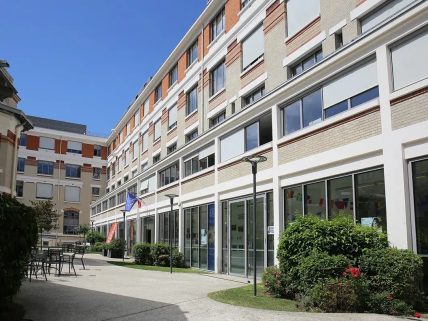
Your engineering school in Paris
Discover our engineering school in Paris: a campus in the heart of the capital, training in AI and Data for a unique student life.
Application
How to apply for the Energy Transition Engineer Program?
Admission to the 1ᵉʳ year of the engineering cycle
Open to students who have validated the first two years after their high school diploma of the Engineering Program of ECE, or in parallel admission to students from the second year of CPGE (thus validating 120 ECTS) and holders of a 3rd year undergraduated validated by 180 ECTS (ATS, BUT, License) in a scientific and/or technical field.
Admission to the 2ᵉ year of the engineering cycle
ECE students who have validated the first three years of the engineering cycle directly join the major.
Open in parallel admission to holders of a 4-Year degree validated by 240 ECTS in physics, chemistry, electrotechnics, computer science, or process engineering. An interest in energy and environmental issues is expected.
How to apply?
- I submit my application online > for the common AVENIR PLUS procedure, if I am currently enrolled in a program of the French educational system (SEF)
- I go through the selection phase. Regardless of the portal: > Review of the application by a selection jury from ECE > Motivation interview by another selection jury from ECE
- I receive the decision
Tuition fees
What are the tuition fees for the Energy Transition Engineering Program?
The tuition fees mentioned below are applicable for the year 2026-2027. They may be revised each year. Financing solutions are available to help you achieve your project.
Students in France 🇫🇷
This category concerns students of all nationalities residing in France.
- If enrolled in a program within the French education system (SEF) 12 months €11 990
- If enrolled in a program outside the French education system 12 months €12 590
Tuition fees for each academic year are communicated to students when they re-enroll for the following year. The ECE offers several financial aid programs.
+70€ : admission fee
Scholarships: How to finance my studies with state assistance?
ECE offers several financing aid options
Meet us
Discover the events of the Engineering program
Event type
-
14/10
Soirée Portes Ouvertes – ECE – Rennes – mercredi 14 octobre 2026
-
14/10
Soirée Portes Ouvertes – ECE – Bordeaux – 14/10/2026
-
17/10
Portes Ouvertes
-
19/10
Immersion in Lyon
FAQ
Everything you need to know about the Energy Transition Engineering Program
The most frequently asked questions about the Energy Transition Engineer Program at ECE are gathered here. Can’t find your answer? Our team is available to talk with you.
Let’s meet
Still hesitating? Meet our teams to guide you in your choices!
This training aims to develop engineers capable of mastering all technical, economic, and financial aspects of the energy sector, identifying the challenges of transition policies, and anticipating changes in the sector.
The teachings utilize artificial intelligence and digital tools to optimize energy systems and transform industrial installations.
At the end of this training, you can directly enter the job market in companies within the energy sector, consulting firms, or local authorities.
Pursuing a doctorate is also possible in fields related to energy systems, environmental policies, or AI applied to energy, thanks to ECE’s network of academic partners.
Yes. This program leads to the ECE engineer title, a level 7 diploma accredited by the Commission des Titres d’Ingénieur (CTI), registered with the RNCP. This title certifies mastery of the technical, economic, and environmental challenges of the energy transition. ECE is a member of the Conference des Grandes Écoles (CGE).
By joining ECE, you become part of a community of over 40 student associations. Clubs related to sustainable development, energy, and entrepreneurship complement formal teaching. These informal learning and meeting spaces help build a useful network in rapidly changing environmental and energy sectors.
Beyond technical skills, this training develops essential abilities to thrive in environments with significant societal and climate challenges:
- Systemic vision of energy and environmental issues
- Ability to mobilize digital tools in a complex decision-making environment
- Communication and popularization of transition issues to various stakeholders
- Analytical rigor in modeling energy systems
- Sense of responsibility regarding climate issues and the constraints of industrial installations
Yes. Two work placements are part of the program: a minimum 4-month internship in the 2nd year of the Engineering cycle and a minimum 6-month engineering internship in the 3rd year of the Engineering cycle, validated by a Final Project. These placements provide a gradual immersion into the energy sector. There is no alternating format in this training: the pace is that of a full-time program.
The Energy Transition major lasts for 2 years, during the 2nd and 3rd years of the Engineering cycle. It is part of a comprehensive 5-year program leading to an engineering degree. The courses are taught in French and English on the Paris campus, with a mandatory international academic stay.
Admission follows three steps: submission of the online application, selection phase based on the application and interview, followed by the receipt of the decision. Open to holders of a validated Bac +4 in physics, chemistry, electrotechnics, computer science, or process engineering, this program is also accessible to ECE students who have validated the first three years of the engineering cycle.
Practical work and modeling projects are integral parts of the evaluation process.
Yes. The teachings in the 3rd year of the Engineering cycle include smart cities and sustainable buildings, as well as energy storage systems, two fields directly related to intelligent networks.
AI applied to the optimization of energy facilities is also at the heart of the program. These teachings prepare students to design and manage smart electrical networks in urban or industrial environments.
Yes. A dedicated module for the decarbonization of industry is included in the official program of the 3rd year of the Engineering cycle. The courses also cover energy markets and mathematical methods for simulating energy systems.
These learnings prepare students to assess the environmental impact of industrial facilities and to design strategies for reducing emissions at the scale of an organization or a territory.
Made for you
Our other Engineering cycle programs
Specializations
Campus
-
- 4- Year Degree
Engineering Program – Major in Aerospace & Space Systems
-
- 4- Year Degree
Engineering Cycle Major in Corporate Finance
-
- 4- Year Degree
Engineering Cycle – Major in Quantitative Finance
-
- 4- Year Degree
Engineering Cycle – Major in Health and Technology
-
- 4- Year Degree
Engineering Cycle – Major in Energy Transition
-
- 4- Year Degree
Engineering Cycle – Major in Digital Transformation & Innovation