


Project-based pedagogy at ECE

Learn by doing
A pedagogy that puts you into action
At ECE, projects hold a central place in training. From the very first year, you work in teams on real-world problems to apply the scientific and technical knowledge acquired in class.
This project-based pedagogy allows you to gradually develop the skills expected of today’s engineers: creativity, project management, collaborative work, innovation capacity, and initiative.
Throughout your journey, you learn to imagine, design, prototype, and deploy solutions addressing real challenges.
Bring new ideas to life
Develop your creativity through ideation
Innovation always starts with an idea.
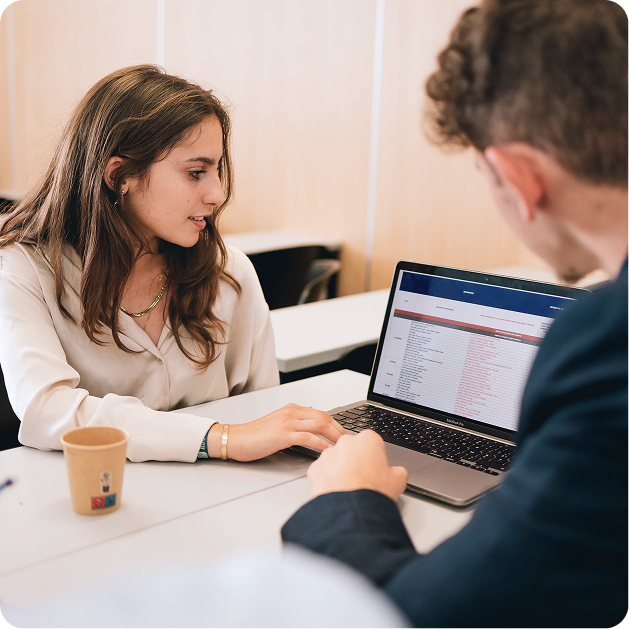
At ECE, students are introduced to ideation methods to learn how to bring innovative solutions to light. Based on techniques such as brainstorming or mind mapping, this creative process encourages collective thinking, experimentation, and idea exchange.
Guided by the educational teams, students alternate between independent work, group presentations, debates, and collaborative sessions to transform an intuition into a real engineering project.
Innovate differently
Student Project Valuation (VPE)
Since 2012, the VPE program (Valuation of Student Projects) has been one of the pillars of innovative pedagogy at ECE.
This program supports students in their last two years of the engineering curriculum through all stages of developing an innovative project: from the initial idea to its realization.
The VPE relies on recognized innovation methods to envision tomorrow’s solutions.
-

Starting your own startup
Turn an idea into a business venture and develop your entrepreneurial spirit.
-

An introduction to research and innovation
Take part in innovative projects and learn about scientific research methods.
-

An introduction to intellectual property
Understand the issues related to patents, the protection of innovations, and the commercialization of technologies.
-

Innovating through partnerships
Collaborate with companies, research labs, or academic institutions on real-world challenges.
-

Enter contests
Present your projects at national and international competitions.
-

Contribute to Open Innovation
Work in open, collaborative environments that foster collective intelligence.
-

Drawing Inspiration from living organisms through biomimicry
Explore new approaches to innovation inspired by the mechanisms of living organisms.
Progress step by step
Projects throughout your engineering school curriculum
In the 1st and 2nd year – Preparatory cycle
- During the two years of integrated preparation, students consolidate their scientific and technical knowledge through a cross-disciplinary project conducted in teams.
- Organized in groups of six, they work using the Agile Scrum method, widely used in businesses. They also discover professional tools such as Jira, GitHub, and the FabLab environment.
- The objective: to prepare for the ECE Cup robotics competition, which brings together nearly a hundred teams each year. Students gradually mobilize their scientific and technical knowledge to design, program, and realize a robotics project.
In the 3rd year
- The ING3 year marks an important milestone with the IMPULSE program.
- Students employ design thinking methods to conceive responsible projects addressing major contemporary challenges: digital transition, energy transition, circular economy, and biomimicry.
In the 4th and 5th year
- Students fully integrate the VPE program through projects focused on real-world issues.
- These experiences allow them to develop operational skills, adopt a professional stance, and create a network even before obtaining their diploma.
Your curriculum
- 1st and 2nd year
- 3rd year
- 4th and 5th year
Work like an engineer
PPE and PFE: two professional experiences
Conducted in the 4th year, the PPE lasts seven months. This innovation project has students work in teams on a multidisciplinary topic, from defining the need to technical implementation.
The Final Year Project, the culmination of the engineering program, is carried out in the 5th year over a four-month period.
Through a high-value-added project, students apply all the skills they have acquired during their studies and engage with the realities of the professional world.
Design without limits
Professional tools at your disposal
3D Prototyping
3D printers, 3D scanners, and computer-aided design software like SolidWorks.
Digital cutting and engraving
CNC milling machine and laser cutting for quickly manufacturing parts and prototypes.
Electronic manufacturing
Equipment dedicated to the design and assembly of surface-mount electronic boards.
Collaborative spaces
Workspaces that encourage exchange, experimentation, and collective project development.