Research Structuring: the axes of LyRIDS
Cross disciplines to innovate
Structured research around major digital challenges
The research conducted within LyRIDS is based on an interdisciplinary approach that combines computer science, mathematics, and physics to address major scientific, technological, and societal challenges.
Research activities are organized around five complementary axes, in line with the expertise developed in ECE’s programs and the needs of the socio-economic world.
The SIC axis develops new representation models, algorithms, and intelligent systems capable of addressing issues related to complex environments.
Research focuses notably on :
- autonomous and connected vehicles ;
- advanced driver-assistance systems (ADAS) ;
- 6G vehicular networks ;
- mobile robotics ;
- the Internet of Things;
- embedded cybersecurity;
- predictive maintenance.
Researchers are also working on generative artificial intelligence applied to communicating systems and smart infrastructures.
This axis develops new mathematical approaches applied to engineering sciences, quantitative finance, and scientific computing.
The main research themes concern:
- partial differential equations;
- optimization;
- the modeling of dynamic systems;
- machine learning applied to scientific models.
Researchers particularly explore the use of deep learning to solve complex high-dimensional equations.
The activities of the NANO axis focus on the design and characterization of functional nanostructured and flexible materials.
Research favors sustainable approaches based on:
- gentle chemistry;
- materials with low environmental impact;
- low-cost processes.
Two main themes structure this axis:
- functional surfaces and nanostructured thin films;
- nanostructured multi-hybrid systems.
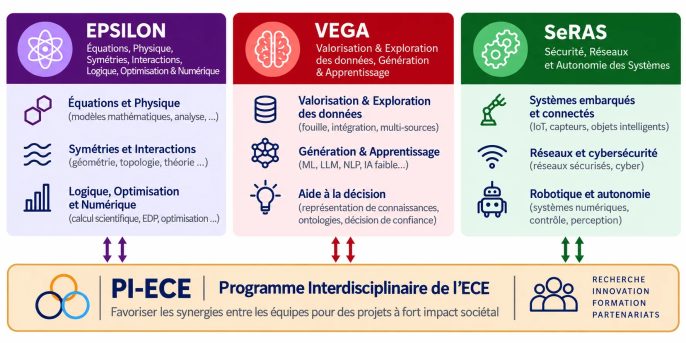
Created in 2018, the PI-ECE program promotes collaborations among researchers from different disciplines to address the challenges of smart cities and the Internet of Things.
This program places humans and their environment at the heart of reflections and mobilizes complementary expertise to design innovative solutions in areas such as:
- health;
- smart cities;
- ecological transition;
- connected objects;
- decision support.
The program brings together teacher-researchers, doctoral students, industrial partners, and engineering students around common projects.
Created in 2024, the cross-cutting GAIA axis is dedicated to the development of responsible and trustworthy artificial intelligence.
The research conducted focuses particularly on:
- the fairness of AI models;
- the robustness and reliability of systems;
- the explainability of algorithmic decisions;
- data protection;
- the transparency and traceability of models.
GAIA brings together the expertise of the laboratory to address the challenges related to the increasing integration of artificial intelligence in our society.
Addressing the challenges of our society
Research in service of humanity
The projects developed within the LyRIDS aim to address major contemporary challenges.
Health and ethics
Engineering for health, cognitive disorders, well-being, and human performance.
Transport and mobility
Driving assistance systems, safety, and intelligent mobility.
Environment and sustainable development
Smart city, Internet of things, environmental quality, and connectivity.
Defense and security
Cybersecurity, predictive maintenance, and defense systems.
Working together to go further
An interdisciplinary research model
The LyRIDS encourages collaborations between disciplines to foster the emergence of groundbreaking innovations.
This interdisciplinary approach combines:
- laboratory researchers;
- engineering students;
- academic partners;
- partner companies.
It allows the development of ambitious scientific projects addressing complex issues in strategic sectors such as health, mobility, artificial intelligence, and smart cities.