


Come study in France
Study at ECE
At ECE, we are proud to welcome students from all around the globe for a semester or an entire year of exchange. These students join us through bilateral agreements previously established with our partner universities.
Application
How to apply to an exchange at ECE?
Nomination of the partner university
Your home university first submits your nomination to ECE via an online form. Once validated, you’ll receive a confirmation email.
Online Application
After your nomination, you’ll receive access to the Mobility Online platform, where you’ll complete your application and upload the required documents by the deadline.
Application Review and Admission
Our team will review your file and update you by an official email sent through Mobility Online.
Application Timeline
Fall Semester and Year-Long deadlines:
– Nomination: May 1
– Application: May 15
Spring Semester
deadlines:
– Nomination: October 1
– Application: October 15
Admission Process (next session: Spring 2027)
- Nomination
- Application
- Admission
Prepare the following documents:
- Passport-sized photograph
- CV
- Language Proficiency Certificate
- Transcripts from all previous relevant Engineering Studies
- Syllabus of current study program
Campus and Academic Calendar
Find our academic calendar and Fall/Spring intake dates to help plan your mobility. All incoming exchange students are welcomed exclusively at our Paris campus.
Campus Paris Eiffel
Where to find us?
Address
10 rue Sextius Michel, 75015 Paris
Transport
Intake Dates
Semester start and end dates by program
Fall
Bachelor – 2026-2027 Programs – Semester 1
- Bachelor 1: October 1st 2026 – December 18th 2026
- Bachelor 2: September 11th – December 17th 2026
- Bachelor 3: October 1st 2026 – December 18th 2026
Msc – 2026-2027 Programs – Semester 1
- M1-M2: October 1st 2026 – December 20th 2026
Spring
Bachelor – 2026-2027 Programs – Semester 2
- Bachelor 1: January 5th 2027 – May 28th 2027
- Bachelor 2: January 5th 2027 – May 31st 2027
- Bachelor 3: January 5th 2027 – April 7th 2027
Msc – 2026-2027 Programs – Semester 2
- M1 – M2: January 5th 2027 – March 31st 2027
Discover our Course Catalogues
As an exchange student, you can apply to various programs available each semester. Upon admission, you’re automatically registered for the program’s full curriculum, which you finalize via your Learning Agreement — submitted before arrival on campus.
To drop a pre-registered course, simply leave it off the agreement.
Courses from different programs and tracks cannot be combined, and are subject to change: always refer to the latest catalogue.
Bachelor Programs
Browse available courses for Bachelor exchange programs.
MSc Programs
Browse available courses for MSc exchange programs.
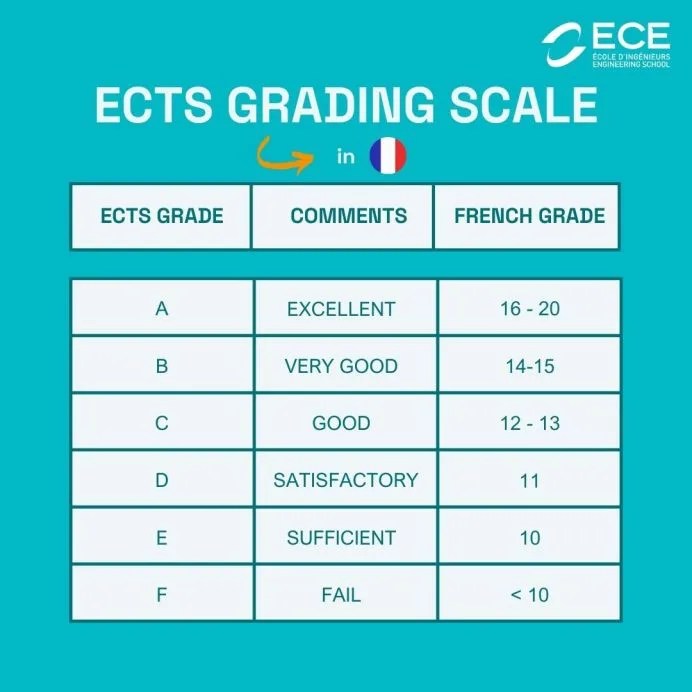
Grading at ECE
60 ECTS credits represent the workload for one academic year and, therefore, as a general rule, 30 ECTS credits are equivalent to one semester of study. ECTS credits, indicate the required workload to complete a study programme, or a module within a study programme. ECTS points only indicate workload; they do not indicate a grade.
The Transcript of Records will only be sent to the International Office of the home university up to 6 weeks after final exams. Only the courses included in the Learning agreement will appear on the official Transcript of Records.
The ECTS system is used by universities and schools for exchange students. ECTS allows credits taken at one higher education institution to be counted towards a qualification studied for at another. When applying for an exchange programme you will need to submit a Learning Agreement.
The Learning Agreement should include all the learning outcomes the student is expected to acquire during the exchange; each course is credited with an ECTS credit. The number of ECTS credits allocated to each course unit is calculated based on the overall volume of work required for the student to meet the learning outcomes at the end of that course unit. It does not only include course attendance hours but also covers practical learning activities and the student’s.
ECE requires all exchange students to take a minimum of 10 ECTS credits.
The French grading system is an absolute grading system. Grades in France and at ECE are awarded on a scale of 0 to 20. 20 being the highest and 0 being the lowest. Grades from 10 to 20 are considered as « pass ». The passing grade that allows students to obtain credits for each subject is 10/20.

We assist you every step of the way
Finding accommodation
ECE does not offer accommodation on campus. We know that searching for housing in France is a long challenge, especially for international students. Rest assured, our team assists you at every step to facilitate your processes. We work with trusted companies and student residences to guide you towards suitable solutions.
We assist you every step of the way
Obtaining your visa
Obtaining a visa is mandatory for non-EU students. Start your application as early as possible through the official France-Visas platform to avoid any delays. A large part of the procedure can be completed from your home country. By preparing your documents in advance, you secure your arrival. The ECE supports you at every step to guide you smoothly.


We assist you every step of the way
Health Coverage
Health insurance is mandatory for all students. EU students must present their European Health Insurance Card (EHIC). Non-EU students must obtain private international health insurance or register for French student social security. Valid coverage guarantees you access to care throughout your stay. The ECE teams assist you in these processes to secure your settlement and your experience.

Is ECE recognised for the quality of its international student reception?
ECE holds the Bienvenue en France Label at Level 2 (2 stars), a certification established by Campus France in 2019 to distinguish higher education institutions committed to improving the reception and integration of international students.
Dedicated international services
Accessible programs
Quality welcome & integration