


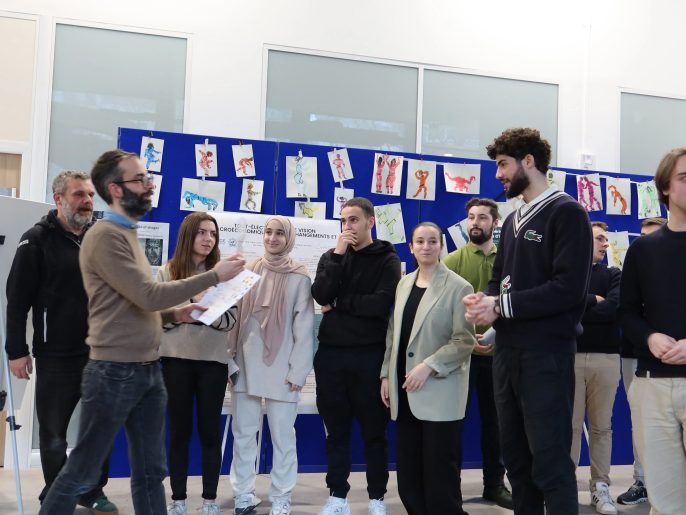
This Tuesday, from 2 PM to 4 PM, 9 student groups defended their study projects at the “Faire Lien” space. Their projects are the result of 6 weeks of independent work.
2 awards were given:
- a “jury” award
- a “public” award
Focus on their work.

More automation in our vehicles
The European Union wants to respond to the number of road deaths; starting in 2024, it will require drivers to have a certain number of driver assistance systems.
This group of students proposes a solution that allows keeping your vehicle, even an old one, while automating it: the installation of an onboard camera equipped with AI capable of enhancing safety and optimizing users’ routes.
A quantitative study of the existing irrigation systems in the Sahel
The need for ever-increasing food production expands the necessary irrigation area worldwide.
These students chose to study the 3 existing irrigation systems in the Sahel, a country marked by frequent droughts. 3 irrigation systems were studied:
- drip irrigation
- sprinkler irrigation
- and flood irrigation.
Drip irrigation was deemed the most effective, particularly because it allows the soil to maintain its moisture level.


A macroeconomic study to understand the impacts of a transition to fully electric vehicles
The electrification of transportation is generating increasing interest, but this change brings significant upheaval at the macroeconomic level. Notably, there will be changes in prices, investment policies, and industrial practices.
Students proposed to develop a model to predict CO2 emissions related to lithium production in China.
Filtering microplastics from water
Every year, humanity dumps between 19 and 23 million tons of plastic into the ocean.
To address this emergency, students propose a method to filter running water by eliminating over 80% of microplastics. They would direct this solution to water treatment plants.


Ability to detect Deepfake
Deepfake refers to the ability to replace a person’s face with another in a video. It is strikingly realistic but also concerning due to its potential to deceive the public.
Students have chosen to study 3 deepfake detection tools and compare, among other aspects
- their working speed
- the minimum amount of data required for them to provide effective work
- their cost
Energy shocks: the ability to quantify economic repercussions
We are undergoing an energy transition related, in particular, to climate change. These changes lead to economic repercussions.
Our students tried to simulate them in order to anticipate upcoming shocks such as lithium shortages, the discovery of a lithium deposit, or the discovery of an eco-friendly technology replacing lithium.


Generating energy… while walking or running.
A group proposed a lightweight, flexible, and flat equipment capable of storing and accumulating the energy we produce while moving.
Optimize every journey…
…using an algorithm. To improve road safety, reduce economic costs associated with accidents, and streamline road traffic, a group wanted to work with 2 algorithms:
- that of Dijkstra
- and that of A*[3]
The first being effective for finding the best possible solution considering distance, speed, road conditions, obstacles, visibility, cost, and ecological aspects.
However, its working speed is slow, which is why the second algorithm, A*[3], will provide quick solutions for long journeys.


Decarbonizing cement
Because cement production is extremely polluting (3rd source of CO2 emissions), a group proposed a model to decarbonize its production chain.
They were able to define 2 methods: one more efficient and costlier than the other, to try to offer a diverse option to the industry.
The laureates
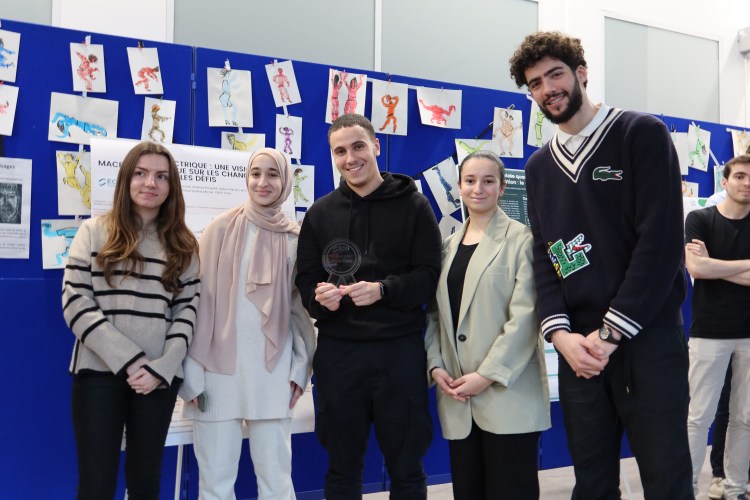
“Public” Prize: Irrigation in the Sahel
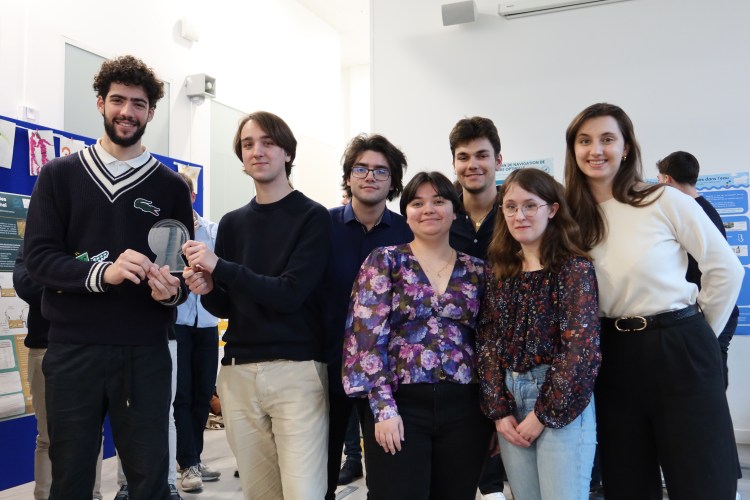
“Public” Prize: Generating energy through running
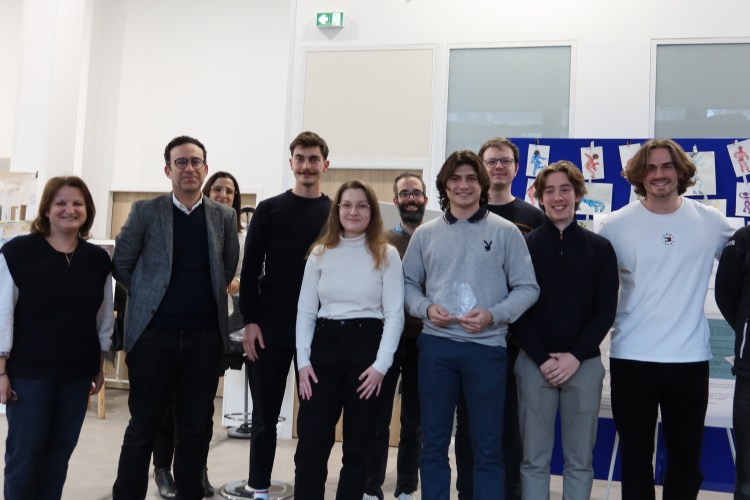
“Jury” Prize: Filtering microplastics from water